Showing posts with label birding. Show all posts

July 14, 2015

Heartbreak Hotel

The fledgling.

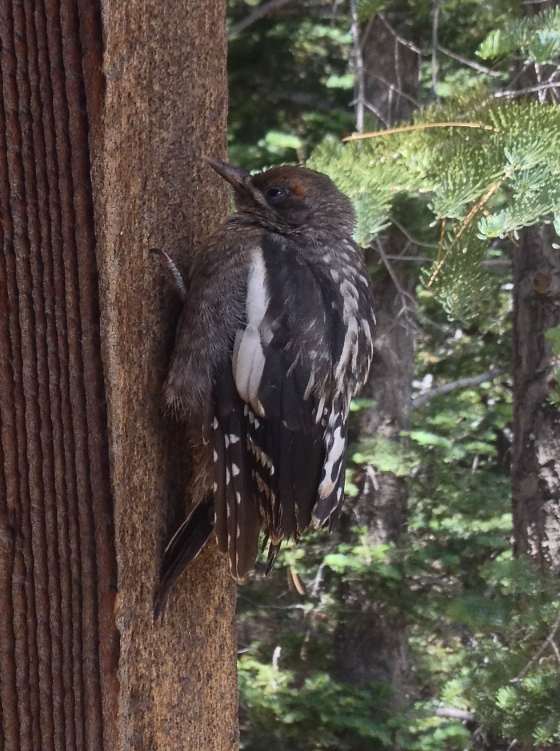
This poor youngster landed on the cabin deck early last week. Parent birds keep an eye on fledglings like this one for some time after they leave the nest, bringing them food and doing what they can to help keep their offspring safe, but every so often there are extenuating circumstances (Fire Department to the Rescue! Happy ending!) and parents aren't around to help. This very young Red-breasted Sapsucker flew in at about nine in the morning, called for his family, preened a bit, pecked at the post, and looked tired. After a while he tucked his head under a wing and slept for a bit.

How I wish I'd offered him some food and water. But no, I was letting nature take her course [kicks self] and didn't want to frighten the parent birds, if they were nearby. They weren't. After several hours he launched away, fell to the ground, and died. 

I felt as if my heart would break, but a deceased fledgling can sometimes be a tiny bit of a deal, so like a good citizen scientist I placed the little guy's mortal remains in a baggie and put the baggie in a paper bag in the freezer. He'll go to legendary bird man Gene Cardiff at the San Bernardino County Museum. Mary Freeman, field trip leader for L.A. Audubon, was at the cabin on Saturday and wanted to take the fledgling to Kimball Garrett at the L.A. County Museum of Natural History, but I said no.  He's going to Gene. The fledgling will "play a vital role in advancing scientific knowledge," as the Smithsonian says. And his tag will always have my name on it, which is maybe the closest thing to immortality a provincial birder can hope for.

Side note: museum collections are awesome. They give me hope for humanity.

Local museums are usually happy to take bodies of wild critters of interest, provided said bodies are in good condition and have been frozen since the critter died. In other words, no mangled remains of something that has been lying on the road for a few days, ick. Unless it's an Archaeopteryx. Use common sense.

And finally, this was a new yard bird for me at the cabin. Such a sad way to add to the yard bird list, but at least it wasn't as bad as watching your life Mountain Quail being killed by a rattlesnake :~(

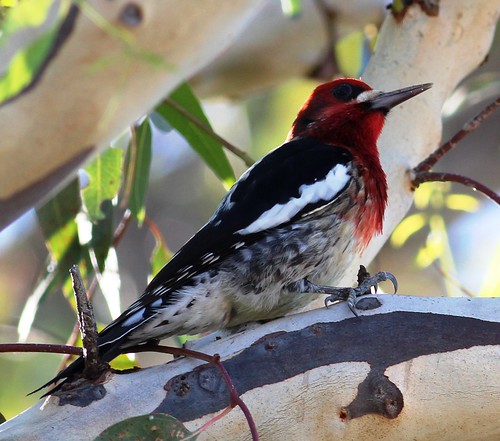
Here's a grown Red-breasted SapSucker, photographed by terrific local birder Tom Benson. I tell myself that the little one's spirit is having a great time flying around bird heaven.
Red-breasted Sapsucker


June 20, 2015

Lake Fire

Untitled

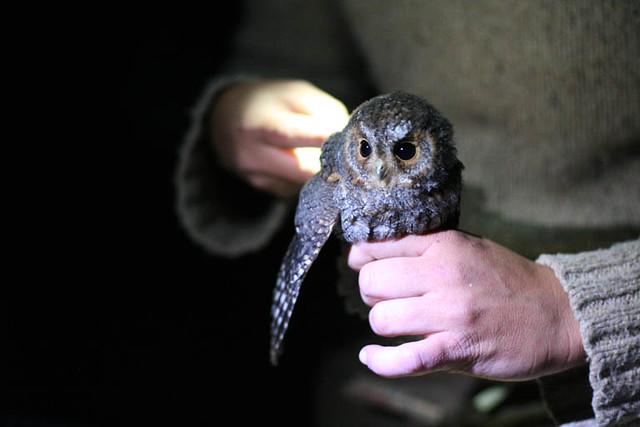
Four years ago at about this time (almost midnight) I was driving back to Big Bear Lake after a night spent owling near Fish Creek, in the San Gorgonio Wilderness area of the San Bernardino National Forest. My fellow birders and I were hoping to see (or hear, more likely) a Flammulated Owl. That's a grown one in the photo above. So small! After prowling the forest roads for a while, we finally heard our owl calling in the old-growth conifers at Mission Springs. It was pitch dark — a wonderful night.

This owling trip has been on my mind the last couple days, because the whole area — the meadow I photographed on the drive in; the forest we traveled through; Aspen Grove trailhead (Violet-green Swallows, Dusky Flycatcher, Green-tailed Towhee...); Fish Creek (Western Tanager, White-headed Woodpecker, Mountain Chickadees, Common Poorwill...); Mission Springs, where we finally heard the little Flamm — all of it is on fire, burned, burning, gone up in smoke, gone up in flames. The Lake Fire ("Incident Description: Moderate Rate Of Spread With Active Torching And Crown Fire Runs") was 16,000 acres in size at last count, and just 15% contained. 

I have a cabin in the San Bernardino National Forest, and fires like this scare the crap out of me. I hope firefighters will stay safe. I hope cabins don't burn. My heart aches for the nestlings too young to fly, the mule deer fawns, the bear cubs. There is no good time for a forest fire, but a big fire at this time of year seems especially cruel. I hope as many of the forest dwellers as possible make it through safely.  

Wildhorse Creek and Wildhorse Meadows to the north, Hell For Sure Canyon to the south. We are not in New England. Aspen Grove, Fish Creek, and Mission Springs, where we heard the little owl, have all burned. Here's the InciWeb link again, and #LakeFire on Twitter.


January 29, 2015

Anna's Hummingbird


Portrait by Brad Schram, who wrote the book on birding in Southern California [no, really, he wrote the book]. Brad is playing (his word) with settings and a new camera body here.

If you ever get the chance to hear Sheri Williamson talk about hummingbirds, give a listen. Not just because she wrote the book on hummingbirds (again, really), but because she's an excellent speaker, and because hummingbirds are awesome. Prodigious migrators, brainy as crows and parrots, masters of flight, and more beautiful than jewels, as you can see from Brad's photo. 

The Anna's is our most common hummingbird here in the foothills — in fact, I've only seen one other species in my yard this past year: a selasphorus, last summer. OK, a Rufous. Maybe. Though it might have been an Allen's:
In some areas, Garrett says, resident Allen's are now as familiar as the Anna's hummingbird, Southern California's most common.
"They're moving inland," Williamson says. "It probably has to do with gardens. It's evolution in action ... the evolution of an urban hummingbird. They're learning to live with people in new environments." [Link]
Sheri's blog is invaluable for anyone interested in feeding these little guys. I am shocked, shocked, to learn that there are chemicals in organic sugar...!

Here are a few photos of hummingbirds taken with an old iPhone, through windows, with way too much zoom, by someone whose hands aren't always steady, etc.

Four Anna's Hummingbirds at one feeder:


Keeping an eye on another feeder. The dead manzanita branches were schlepped down from the cabin: 


Shadow play: 


And finally, a handsome boy guarding yet another feeder. He's perched on an agave spine:


(Agave + needlessly ginormous pot = epic fail. Look, a hummingbird!)


December 16, 2014

Evening Grosbeaks in Big Bear

Merriam-Webster: "part translation of French grosbec, from gros thick + bec beak."
As always, click to embiggen.

I HAVE NEVER SEEN ONE. They better stick around for a while, is all I can say. Lance Benner recorded their flight calls last week: check out his recording on Xeno-canto. At last report there were 20 - 25 of them continuing south and west of the Big Bear Lake City Hall/Civic Center. Look up in the treetops. Did I mention that bears are occasionally spotted along Metcalf Creek? Anyhow, it's beautiful country — and now that the ski resorts are open, traffic will be nuts. Drive safe.

Photo by Cephas: Source

August 13, 2011

Incoming: Eurasian Eagle-owl


Feather trivia, because I was reminded of it while watching this owl fly in and prepare to land, or make landfall: as you all know, flight feathers are called remiges [singular remex] from the Latin for oarsman; tail feathers are called rectices [singular rectrix], from the Latin for rudder or helmsman.

The Eagle Owl in the video is a cousin of our North American Great Horned Owl — they are both eagle-owls, members of the genus Bubo. More eagle-owls!

Same vid with a few extra seconds added.

Speaking of owls: I saw a Long-eared Owl near Big Bear Lake last month — rather a rare sighting, lucky me. Horrid photos here.


July 11, 2011

I never see nuthin'


Aside from dozens of busy, vocal Pygmy Nuthatches and a sky full of Violet-green Swallows sailing in and out of their nests, there weren't many birds along the trail a few of us hiked Sunday morning.

[W]hen you go into the woods, even on the dullest of days, you never see nothing. [T-FB]


Not many birds — but a whole lot of other things to see. Exhibit A: thousands of ladybugs milling around their hibernating place under the pine needles. I snapped a picture of a handful of them, and got some Sticky Cinquefoil [Potentilla glandulosa, a member of the rose family] in the photo as well. Is Sticky Cinquefoil really sticky? Glad you asked: "It is usually coated in hairs, many of which are glandular, giving the plant a sticky texture." [Source.] Yes. Click the photo to embiggen.

This particular ladybug is Hippodamia convergens, correctly known as the Convergent Lady Beetle, thank you very much. "In the western United States, adult convergent lady beetles typically spend up to nine months, from May to February, hibernating in large aggregations in mountain valleys," sez Cornell. Check out these terrific photos at Cornell's Lost Ladybug Project. The Lost Ladybug Project is quite wonderful, and looks a bit like an eBird for ladybugs. From the home page:
Across North America ladybug species distribution is changing. Over the past twenty years several native ladybugs that were once very common have become extremely rare. During this same time ladybugs from other places have greatly increased both their numbers and range. Some ladybugs are simply found in new places. This is happening very quickly and we don’t know how, or why, or what impact it will have on ladybug diversity or the role that ladybugs play in keeping plant-feeding insect populations low. We're asking you to join us in finding out where all the ladybugs have gone so we can try to prevent more native species from becoming so rare.
If I'd known about the Project beforehand, I'd have taken better photos and sent them in. Next time...

Also check out this, from Cornell's site on biological control:
Commercial insectaries distribute beetles that have been "harvested" from natural winter aggregation sites. If lady beetles are collected in this dormant state and transported for field release, even among aphid infestations, they usually migrate before feeding and laying eggs. This migratory behavior before feeding is obligatory. Releases of such "harvested" convergent lady beetles could be a waste of time, money, and beetles. Insectaries may feed the adult beetles a special diet after they have been collected to minimize their migratory behavior. Only such preconditioned beetles should be purchased. Additionally, these harvested beetles may be parasitized.
More here. Food for thought before purchasing that bag o' beetles for your organic garden.

The trail to Sugarloaf Mountain, unlike the ladybug hike, was crazy with birds. More on that trip [with ossum photos by Pam Kling] soon.

[The title of this post was swiped liberated from this great entry over at Two-Fisted Birdwatcher.]

July 8, 2011

Suet craftiness. Also: Flickr Friday


For those of you who put out some version of suet or Zick Dough or Bark Butter for the birds, and are too broke and/or too cheap to shell out $$ for a feeder, well... walla, as we say here in California.

Step #1. Find a gnarly old piece of wood. The more canyons and craters, the better.

Step #2. Scrounge around in the garage or the pantry or wherever you keep little containers of small, used and useful items until you find an old screw eye.

Step #3. Put screw eye into one end of the wood. Fill canyons and craters with your preferred suet mix. Hang the thing in a tree. Done!

Took my gang here at the cabin about ten minutes to discover the new food source. Now it's popular with nuthatches, chickadees, grosbeaks, jays, woodpeckers, flickers... all the usual suspects.

*************

If you are in Big Bear this weekend for the PaddleFest or the Corvettes West Big Bear Bash or just to escape the down-the-hill heat for a few days, swing by the Discovery Center on the north shore and check out the swallow nests. (Great [dog-friendly] gift shop, too.)

There are nest boxes scattered here and there, and a few nests in trees like this defunct juniper:


Going in...

And coming out. Yep, a Violet-green Swallow ;~)

Here's a much, much better photo of a gorgeous Violet-green by Donald Metzner on Flickr.  He writes, "When this guy turned and the sun came out from behind the cloud, it was like he just lit up, amazing colors[...]" And those wonderful long wings. A beautiful bird:


See more of Donald Metzner's terrific photos here, at Flickr. Also on Flickr, Larry Jordan of the most excellent Birder's Report has a series of photos of an adult Violet-green feeding a nestling. See Larry's post on the Violet-green's cousin the Tree Swallow here, with wonderful photos.

July 7, 2011

Great and Gray

Found a beautiful video by Sparky Stensaas of my favorite owl, the Great Gray. Saw one hunting at dusk in Yosemite National Park while I was birding with Gene Cardiff and a group from SoCal, years ago. Just as I looked through the scope, the owl raised his head and looked straight at me. I felt some of what Mole experienced during his encounter with the Piper at the Gates of Dawn: "it was an awe that smote and held him [and] he knew it could only mean that some august Presence was very, very near." This will give you an idea:


Saw that Great Gray Owl — my first — in a meadow near Crane Flat, and another hunting in a different meadow the following morning. Unforgettable.

Found this video via Birdchick on Facebook, after she linked to the latest cool vid on Sparky's excellent blog: baby Brown Thrasher versus baby Garter Snake.

Related snake/bird post:
Killing at Arrastre Creek

July 5, 2011

Evening linkage

To the left is one of a series of alternate, for-promo-only posters for The Black Swan, created by design group LaBoca. See all of them at Scott Hansen's site.

The Zen Birdfeeder has a post on Juvenile Purple Finches and their antics, which reminds me of these photos of a good finch dad, taken here at the cabin last year by an L.A. Audubon member. Sweet ;~)

Loons and lead: read it and weep. Then surf over to Phillip Loughlin's The Hog Blog, and read a thoughtful hunter's commentary on this issue.

"We had another bird that went almost down to I-15 in the San Gabriel Mountains." That's an hour away from me [faints]. My sis, who lives up in San Jose, was the first to send me this news about wide-ranging California Condors. [Devastated by lead ammunition, the condor.]

Bryan D. Hughes's site Fieldherper.com has a gorgeous shot of a Black-tailed Rattlesnake in New Mexico's Guadalupe Mountains.

The Reptile Rescue Squad: Ashwin Baindur's daughter Aditi chronicles the rescue of a Russell's Viper, one of the most dangerous snakes in India.

Speaking of which: in The Truth About the Speckled Band, legendary venomous-snake authority [and Baker Street Irregular] Laurence Klauber reveals the identity of the... creature that killed Julia Stoner and Dr. Grimesby Roylott of Stoke Moran [shudders]. It wasn't a Russell's Viper, people.

More science news: Scientific American introduces its new blog network, with a stable of impressive bloggers [and Bora Zivkovic as Blog Editor, which bodes well]. For science geeks [like me] who love science blogs, this is very cool news. No such thing as too many outstanding science blogs these days, as far as I'm concerned.

Independence Day: nests, loons, coyotes, and Cactus Flats


Nice spot for a nest. That's a Steller's Jay nest atop a spring off Forest Road 2N10. I'm told the babies grew and fledged just fine, if a bit damp. Click to embiggen.

A friend from down the hill drove up yesterday, and we spent some time checking on a few species around the lake. Near the spring above, we got a good look at a Golden-crowned Kinglet. [More info on this species here.] Note that I linked to a photo of this tiny bird, since I'm much better at taking pictures of things that hold still. Nests, for example. Here's a Robin's nest near that same spring, discovered by birder Linda Gray of Lake Arrowhead.


In the meadow south of the old I-S Ranch we spotted a familiar face tail. First coyote of the summer! [Saw another one about ten feet from the cabin earlier today, big and healthy-looking. Teach me to worry about our song dogs.]


Think he sees us?

Nah.


On the north shore we stopped to check out the Common Loons near Grout Bay.


[Sandy's photo is much better.] Then we drove down Cushenberry Grade to Cactus Flats, spotted a Loggerhead Shrike and several beautiful Black-throated Sparrows, and contemplated the great variety of habitats around Big Bear. Here's looking at you, Arizona [from FR3N03]:


Finally, this:


Seriously, how can you drive up to the lake for the 4th of July, let alone live anywhere near the mountains, without knowing that personal fireworks are banned, banned, banned with a ban-hammer in the San Bernardino National Forest? It's the fire hazard, stupid. Snapped this photo of county sheriffs confiscating a ginormous box of illegal fireworks at Grout Bay yesterday. Only you can prevent wildfires...

June 30, 2011

Nest-building: Western Wood-Pewee


I love this photo. [And I owe you one like this, after the previous post.] Click for big. Pamela Kling took this shot of a Western Wood-Pewee putting the finishing touches on her nest of grasses and moss and spider webs, high in the elbow of a pine bough in the San Bernardino National Forest. [Photo used with permission.] Spotted the nest  on the north shore of Bluff Lake, where everything is green and beautiful, as you can see from my snapshot below. As I've said a few dozen times, the difference between the west [green] end of the Big Bear Valley and the dry, near-desert east end never fails to impress.


Killing at Arrastre Creek


There they were, a beautiful big family of Mountain Quail — adults and a dozen young 'uns, recent hatchlings — crossing the dry creek bed a few steps ahead of us, and the next thing we knew, one quail chick was down, doomed, kicking and thrashing in those remorseless jaws. Poor little tyke died before our eyes. Field trip leader Pamela Kling of Pomona Valley Audubon took the photos you see here, posted with her permission. Click on the photos to make them [very] big.

This is the deal about birding [and my friend and birding idol Gene Cardiff says it's the best thing about birding]: you get out into some beautiful country, and you see all kinds of things.

Southern Pacific Rattlesnakes are a common sight along Arrastre Creek. Mountain Quail, not so much. A rattlesnake killing a Mountain Quail is a rare sight indeed — and one of those events that might make you think a bit more carefully about where you put your feet for the rest of the hike. [Remember that as long as you don't pick one up, the odds of a rattler biting you are slim.]

I'm sure the rattlesnake at Arrastre was aware of our presence, though he never displayed any agitation that I could see. Once the quail chick stopped moving, though, the rattler worked his jaws around to the head and dragged the chick out of sight: a concession to us nosy humans.


For more about our local rattlesnakes, check out this post. And man, it was piteous listening to the quail babies calling from the shrubs next to the creek that whole time, let me tell you. [Mom was stuck on the other side.]

For more on California reptiles:
California Herps: A Guide to the Amphibians and Reptiles of California
And at the link above, check out Rattlesnake Signs and Art for your rattler signage fix o' the day.

June 22, 2011

On the road to Fish Creek


A look back at the meadow below Heart Bar, around 7:00 PM on June 20. Found our Flammulated Owl at 9:30 or thereabouts — the forest was black and the night sky was incredible... so full of stars. The Flammulated is a tiny owl, about the size of a White-crowned Sparrow. Take a look at this shot on Flickr by bird bander Marissa B, and you'll see what I mean.

Birds and bikes on the road to Bluff Lake


Snapped a Western Bluebird by his nest in what's left of a dead tree on June 19, off Forest Road 2N10 on the way to Bluff Lake. Click to embiggen, and take pity on my antique point-and-shoot. The little Black Oak our bluebird perched on isn't dead - it just hasn't leafed out yet. Spring was cold this year. Over Memorial Day Weekend, temps at the cabin were in the mid-20s F, brrr. Today's temps were in the 80s, and all the oaks around the cabin are filling out beautifully.

Stopped at the spring off 2N10 and found a pair of Golden-crowned Kinglets, Red-breasted Sapsuckers and a Brown Creeper, among other sightings. The Steller's Jay nest is still sitting on top of the spring.

Birders heading to Bluff Lake always share FR 2N10 with a few mountain bikers, but Sunday was extreme. Race day!
This past Sunday cyclists came from across California, Oregon, South Africa, Mexico and beyond to compete in the Kenda Cup Team Big Bear Mountain Bike Race Finals in Big Bear. This event was also part two in the Conquer the Cub and Conquer the Bear series, part of Open Air Big Bear. The event had a special element to it this year, incorporating a 50-mile marathon race, along with the standard 18 mile and 24 mile course loops. 
I was birding with Linda G. from Lake Arrowhead and some nice folks from one of Sylvia Gallagher's great classes down in Orange County. On the way up to Bluff we pulled over while a hundred or so mountain bikers flew past us going downhill — very cool. Some irate chucklehead in a vehicle behind us marched up to my truck window to steam about his rights to drive anywhere unimpeded at any time, yadda yadda, and Laurel [OC birder] and I were like, dude, get over yourself. [This bike race is held once a year, and it's not like the whole thing wasn't publicized. Sheesh.] Check out this race photo from Big Bear News:


So we were held up a bit, but no biggie, and Laurel and I made great time on the way back. Too great, actually... The other birders drove more slowly and kept their eyes open and were rewarded with the only White-headed Woodpecker sighting of the day.

I really want to take some of Sylvia Gallagher's classes now.

Linkage:
Conquer the Bear, from Big Bear News
“Conquer the Bear” Mountain Bike Race, from the Big Bear Blog
Bird Classes for Adults, Sea & Sage Audubon Society

April 1, 2011

San Timoteo Canyon

new growth, a photo by FromTheTrunk on Flickr. Click to embiggen.

Ah, I love this photo.

San Timoteo Creek is down there between the groves and the willows. Saw some beautiful Hooded Orioles there earlier this week. Check out the bare patches where slabs of hillside gave way during the December 2010 rains. Those green hillsides will be brown soon if it stays as hot [92F] as it was today.

March 25, 2011

Flickr Friday: Le Conte's Thrasher

Le Conte's Thrasher in song, Elkhorn Plain, Carrizo Plains National Monument, San Luis Obispo County, CA. March 10, 2011. Photo by Brad Schram on Flickr.

Today's featured photographer is Brad Schram, who in addition to being a terrific photographer and world-class birder is also the author of A Birder's Guide to Southern California. A most excellent book and a must-read, not just for those planning SoCal birding trips, but for locals as well. This book is a gold mine of information for Southern California birders, if you ask me.

Check out Brad's Flickr photos here.

For more information on the Carrizo Plain, see these sites:
Carrizo Plain National Monument [Bureau of Land Management]
Carrizo Plain [Wikipedia]

March 23, 2011

Lawrence's Goldfinches at San Timoteo Creek


"Striking in appearance and enigmatic in behavior": Lawrence's Goldfinch, Carduelis lawrencei, a photo by Bill Bouton on Flickr.

On Sunday my buddy Linn, a.k.a. Hawkeye, called with an invite to bird Hulda Crooks Park in Loma Linda before the storm arrived. Local birder Tarik Townsend had seen Lawrence's Goldfinches at the park, and selasphorus hummingbirds [pdf] had been spotted there too, so we bundled up against the cold and headed off with those species in mind.

From the Cornell Lab's All about Birds:
A handsome and uncommon small finch, Lawrence's Goldfinch breeds across a small range in the woodlands of California and Baja California. Its highly erratic movements from year to year make assessment of its population trends very difficult.
They migrate east/west — how cool is that?

I'd seen one at Cal State San Bernardino in early February when Tom Benson led a beginner bird walk there — Tom wrote that it was the earliest in the year he'd seen one on campus by about a month. Linn hadn't seen one yet this year.

The clouds were pitch dark and spitting rain, but we did get some good looks at a selasphorus hummingbird [he had a brown back and a bland throat, so I'm thinking hatch-year male Rufous...?] right before the storm began in earnest.

Or we thought it began in earnest. But it only poured for five or ten minutes, and then quit.

So after a quick Starbucks run we drove down Fern Avenue to San Timoteo Creek and a little marshy area off San Timoteo Canyon Road. We hadn't been there for more than a minute when Linn found four, count 'em, four Lawrence's Goldfinches in a dead tree just north of the creek. Quite awesome — two handsome males and two females. After a minute they flew off to the northwest, but we stuck around a bit longer to check out the resident Yellowthroat, a few swallows [no Cliff Swallows yet - they nest under the nearby bridge], the ubiquitous Yellow-rumps, and the Red-winged Blackbirds. Then we quit, because it was about 50F freezing cold. The storm hit later that night, flooding area roads and bringing tons of birds to my feeders the next day, as rainy weather tends to do.

San Timoteo Creek between Fern Avenue and Alessandro Road is a good place to bird: see more here and here [map, pdf].

The Flickr photo above was taken by Bill Bouton at Chimineas Ranch in San Luis Obispo County, California.

See also:
Davis, Jeff N. 1999. Lawrence's Goldfinch (Spinus lawrencei), The Birds of North America Online (A. Poole, Ed.). Ithaca: Cornell Lab of Ornithology; Retrieved from the Birds of North America Online: http://bna.birds.cornell.edu/bna/species/480
doi:10.2173/bna.480

March 18, 2011

Flickr Friday: California Gnatcatcher

California Gnatcatcher in the river wash north of Mentone, CA on March 13, 2011. Photo by Sandy Remley on Flickr.

There was once a time, and I'm old enough to remember it, when our little corner of Southern California had just one small subdivision nestled in a sea of orange groves. And there were no freeways! The mind reels. At least the flood plain of the Santa Ana River north of town hasn't changed too dramatically. Access to the wash is more restricted, it's true, but that just means walking a bit farther through the boulders and the chaparral, or finding someone with the right kind of vehicle who knows the dirt roads and the lay of the land. And what a payoff: I was out in the middle of the wash one bright morning last week just eight or ten feet away from a California Gnatcatcher.

These beautiful little birds live only in Southern California and in Baja California, Mexico. Our north-of-the-border subspecies "has been listed as a Species of Special Concern in California and was listed as Threatened by the U.S. Fish and Wildlife Service in 1993." Here's the science.

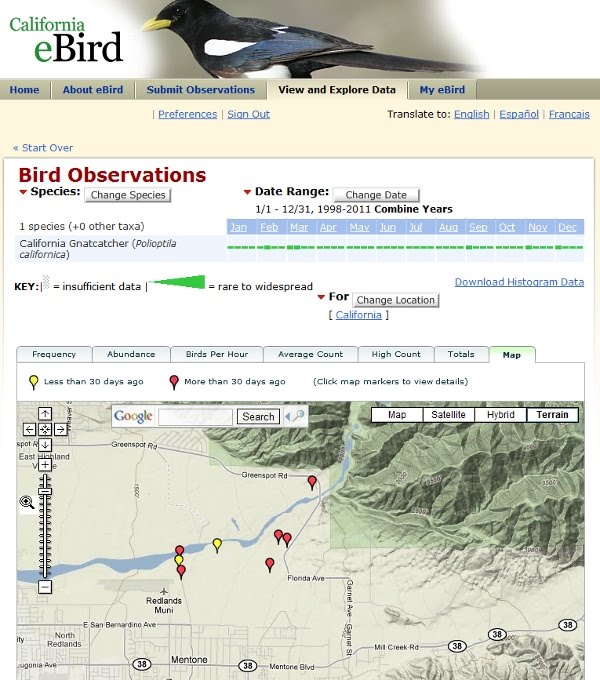
From 1960 to 1990 there were just four recorded sightings of this species in San Bernardino County. There were seven more sightings in the 1990s, and to the left you can see what the eBird map looks like for the years 1998 - 2011 [click for big].

Sandy Remley is this Friday's featured photographer. Sandy also happens to be one of the region's best birders, and this year she's doing some chasing. Her goal for 2011: 300 species in San Bernardino County. [It's been done before — once.] Sandy has 174 species so far and is #1 on the 2011 list of San Bernardino's Top 100 eBirders, so I'd say she's well on her way. You can check out Sandy's Flickr site here.

Last weekend Sandy asked if I'd like to go after a few local species with her, and we were bird magnets — it was a good day birding. It was also a reminder for me of the diversity of habitat in our valley and its importance for birds [and birders].

We heard the handsome male California Gnatcatcher pictured above calling from the moment we arrived in the wash, and we heard another calling close by. Cactus wrens were chasing each other, a California Thrasher made an appearance, towhees [California and Spotted] were there, and several Blue-gray Gnatcatchers dodged around the salvia and the yerba santa on the opposite side of the road. Rabbits and California Quail slipped through the sage scrub, and a Cooper's Hawk flew overhead. Always makes me think of a remark by master birder Gene Cardiff: "The best thing about birding is that it gets you out into some beautiful country." Amen.

Not too far away: A runner approaches the end of Opal Avenue. Photo by JudyRutRider.

See also:
Atwood, Jonathan L. and David R. Bontrager. 2001. California Gnatcatcher (Polioptila californica), The Birds of North America Online (A. Poole, Ed.). Ithaca: Cornell Lab of Ornithology; Retrieved from the Birds of North America Online: http://bna.birds.cornell.edu/bna/species/574
doi:10.2173/bna.574

Mock, P. 2004. California Gnatcatcher (Polioptila californica). In The Coastal Scrub and Chaparral Bird Conservation Plan: a strategy for protecting and managing coastal scrub and chaparral habitats and associated birds in California. California Partners in Flight. http://www.prbo.org/calpif/htmldocs/scrub.html

US Fish & Wildlife Service Species Profile

10,000 Birds: Finding and Identifying a California Gnatcatcher

What we talk about when we talk about love

Nico feeding the birds, by Ian Muttoo [Nico's dad] on Flickr. This is quite possibly the best photo ever.

[Man, I should carry a copy of that photo around, just to show people why teaching can be the best job on the planet.]

Nature never became a toy to a wise spirit. The flowers, the animals, the mountains, reflected the wisdom of his best hour, as much as they had delighted the simplicity of his childhood.
~ Emerson

I took a group of middle school kids birding the week before last, and a very yellow, very cooperative Lesser Goldfinch on a low branch at the park had them so wide-eyed that you'd have thought it was Kevin from Up. The same thing happened last month when we found a young Cooper's Hawk at school, perched on a fence twenty feet away, looking awesome. The kids were spellbound. You can't pay for moments like that, I'm telling you.

Anyhow, that photo made me think of the time my little sister and I hand-fed chickadees up at the cabin, and oh, how I wish my parents and my great-aunt were still alive so I could hug them and thank them for those days, for the quail that came to be fed each afternoon, for the walks in the forest, for the binoculars and field guides that were always there... thank them for everything.

Over at Punk Rock Big Year, Paul Riss has a beaut of a post up about parents and kids and moments like the one above.
I took my kids to dance class. Now, my father never took me to dance class that I'm aware of but who knows. I barely remember the last ten minutes, never mind the last 30 years. What my dad DID do was take me to a conservation area with an old pair of binoculars to see a few birds. I really have no recollection of how it went leading up to the moment I became insanely obsessed by birds. I don't remember standing in the woods with my hand held out, waiting. I don't remember the type of seeds in the palm of my hand. I don't remember what time of year it was or what time of day it was. I don't even remember what car we drove there. What I do remember with intensity, is exactly how heavy (or rather not heavy) a Black-capped Chickadee was. How it's impossibly small silver-grey legs looked, and how the tiny claws at the ends of it's toes felt on the palm of my hand.
[...]
I wish I was able to see my face at that moment. I bet dad remembers my expression. If there's one thing you tend to remember, its when your child is ecstatic about something you did for them...
Head over to Punk Rock Big Year and read the whole thing.


See also:

[H/T for the photo: Wildlife Garden.]

March 1, 2011

Missed

Mike San Miguel on a pelagic trip out of Bodega Bay, California, September 9, 2009. Photo by Kristen Olson on Flickr.

There were many reasons to admire ardent conservationist Mike San Miguel, who died last year while conducting owl surveys for SoCal Edison in the San Gabriel Mountains. For one thing, Mike "offered his time and energy as a volunteer data reviewer for San Bernardino County, California," to quote eBird's tribute, and that was a big deal for me, because I happen to live and bird in San Bernardino County. For another thing, Mike led field trips for L.A. Audubon, offering his time and his considerable birding expertise to bring people closer to the life of the skies.

Mike's generosity of spirit meant that run-of-the-mill, garden-variety birders like me had the opportunity to go birding with one of the best field ornithologists in North America — except that I never did get the chance to go birding with him, because birding with Mike San Miguel was a Special Thing that I was saving for the future, when my birding skills would be better. And now it's too late.

"He was one of those guys that made you feel better when he was around. Because he was so full of the right stuff."*


Kimball Garrett reported Mike's death to the online community of California birders the day after the tragedy occurred, and handled the somber task with skill and eloquence. If I were ever faced with such a heartbreaking responsibility, it would be a miracle if I managed to write a message half as fine and heartfelt as Garrett's post about Mike. The folks at eBird weighed in with tributes of their own, and Mike's son and daughter added beautiful posts that speak volumes about their dad. All are very worth reading. His daughter writes:
I ask one favor of Dad's dear birding friends; next time you chase a great bird, get it in your sights and get a good look, take a moment to think of Dad. That way I'll know he's still out there birding with you.
Mike San Miguel was a beloved family man, a citizen scientist of the highest rank and an inspiration to more people than he could ever have imagined. My eBird-list-per-day resolution this year is in memory of Mike. "Birding with a purpose," Kimball Garrett called it — all our small lists and Mike's vastly more extensive ones helping people learn more about birds and the environment, now and a hundred years from now. A friend calls it "birding in the spirit of Mike San Miguel."