August 25, 2017

Flashback Friday

Sunday morning, with border collie and barrels.

A kind and extraordinarily generous neighbor gave me this humongous golden barrel (Echinocactus grusonii) last week. To say I was flabbergasted doesn't even come close. "Are you sure? Are you sure?" He was. His dear wife — she passed away a year ago — had brought this cactus home when it was smaller than a grapefruit, had looked after it for decades, and my neighbor wanted it to go to a good home. I was moved and honored. You can see what wonderful care this barrel has received: it lived in (increasingly large) pots, sheltered from rain and snow, with filtered sun in the morning and shade in the afternoon, until it grew so big that its size and spines became a hazard. 

So how do you move a 200+ lb barrel cactus? Believe it or not, we didn't even need gloves. Three men and yours truly used a dolly to get this beautiful barrel into my yard and settled in its new pot, and we were able to do it because I'd had the opportunity to watch a master cactus-mover at work.

Rob Roy MacGregor is a Riverside plantsman and cactus maven, and back in April I watched Rob (with cactus fanatics Aaron and Paul) move big barrels like this one into the bed of Aaron's truck, using not much more than a long piece of old shade cloth. Rob puts the shade cloth around the barrel, and uses the loose ends to maneuver the barrel without risking life and limb, and without harming the cactus. It works! Two strong men with shovels had tried and failed to budge this beauty toward a wheelbarrow (never mind into the wheelbarrow) after it fell out of its old pot, but with shade cloth in hand, we moved it to my place with the dolly, potted it in its new, 24-inch container (with an essential plant caddy), and then potted up another barrel at my neighbor's. Note to self: always keep old shade cloth handy.

Before it came to my yard, this cactus lived for years in a big container at my neighbor's house, in dirt. Not potting mix or cactus soil with pumice added — just native clay soil. Wish I'd thrown a few handfuls into the current container.

So now the girl who swore she'd never have a golden barrel has four of them, three little ones and a very, very big golden barrel, all in my very, very small backyard. "Don't be afraid to use big objects in small spaces," right? One more photo, with Jasper yawning and stretching: 

I'm not in the habit of giving names to plants. Anyhow: golden barrels Huey, Louie, and Dewey are in the background. I'd kind of like to call the new guy Jonathan Gold, because he is blond and on the round side and sharp as a tack and thoroughly awesome. 

(Both these photos were first posted on my Instagram account. Here's a link.)


August 22, 2017

Inter-City Cactus Show and Sale 2017

This beauty is a Melocactus. Frost-tender, so I should avoid them.

Great plants and great plant people at the L.A. Arboretum weekend before last for the The 32nd Inter-City Cactus and Succulent Show and Sale. Saw many plant-loving buddies, and enjoyed a picnic lunch with Denise of A Growing Obsession. (Denise is one of the nicest, coolest people you could ever hope to meet, and her blog is sensational.) I had a wish list of exactly two plants, and failed to find either one at the sale. Bought a few others instead :~) Also bought about 50 lb of top dressing. A few photos:

Ecninocactus texensis was one of the two species on my want list. You can see why: it's gorgeous, and not huge. It's also hardy to at least 15° or 20°F.

Not much into plants with caudices, but if I were, I'd have tried to smuggle this beauty home.

 Uebelmannia pectinifera, endemic to Brazil, turns a deep chocolate or purple color in sun. Fabulous looking but said to be a challenge to grow. Low tolerance for cold.

Dream plant right here: a gorgeous, variegated Ferocactus. Just perfect.

This variegated beauty is a hybrid between a Ferocactus and a Thelocactus, both species native to Mexico and the Southwest.

One Astrophytum...

... three Astrophyta? Plants in this genus are native to the Chihuahuan desert. "Easy and hardy," says palmbob. Good from 125°F to 20 °F.


Echinocactus parryi, high on the want list. Another native of the Chihuahuan desert.

Gorgeous little agave - sorry I didn't get the name of this one.

Agave parviflora v. flexiflora, now on the want list. This variety is native to the Mexican state of Sonora.

Running from a hungry Arboretum peacock. Denise saved me by offering it a small child.

My new Thelocactus bicolor, yet another Chihuahuan desert native, blooming like mad in the truck on the way home. I love the Inter-city show.


March 19, 2017

Season's Greetings

The Calliandra hybrid 'Sierra Starr' went from bare to blazing overnight. 
Click photos to embiggen.

I'm so glad it's spring. You all know what winter was like, and there are no words for how grateful we Californians are for the rain and snow. However. When the weather gets wet and cold (lowest this winter here was around 26 F), I need to protect some plants. And then I need to un-protect them when the sun comes out. Dozens are moved under the patio roof, and another dozen or so are moved inside. This is what my yard looks like, all frost cloth and plastic sheeting and upside down nursery pots, off and on and off and on, from November until early March:

Ferocactus kindergartners under there somewhere. 

Precipitation shots. These guys were on their own:

Agave x leopoldii

Mason Valley Cholla, Pink Teddy Bear Cholla
Cylindropuntia fosbergii

Opuntia basilaris hybrid 'Baby Rita.' 'Baby Rita' is standing up straight now. Some opuntias stage a swoon in cold weather.

"Opuntia sp. 'Old Mexico' appears to be a spineless selection of Opuntia gomei, a native just barely to the southernmost coast of Texas and more abundantly down into Tamaulipas. The cultivar name comes from Helen Wynans, a cactus dealer in Brownsville in the 1970's and 80's," says Mountain States Wholesale Nursery. 'Old Mexico' is a favorite of mine - this one was started from a cutting gifted to me at Riverside's legendary, now closed, much missed Mexican Hat Cactus Nursery. 

Lovely Aloe microstigma bloomed for me last year, but not this time around. I've given away all but a handful of aloes - they hate the winter here, and burn in the summer.


I thought the cold, wet weather would never end, and then, overnight, everything started to wake up. The foothills began to turn green - greener than they've been for years. I drove up to El Dorado Ranch Park for a morning hike with a view. (It was 33 F before the sun came over the ridge.) El Dorado Ranch is a beautiful open space preserve a few miles away off Oak Glen Road, with miles of hiking trails through the foothill chaparral. I still fantasize about having a little ranchito (horses, chickens, a donkey...) in a setting like this:


Friend Gerhard Bock stopped by on his way to Palm Springs, and we checked out the Jurupa Mountains Discovery Center and Granite Hill Nursery. Visit Gerhard's blog for great photos of Jurupa. I snapped a favorite - this is Ferocactus pilosus, the Mexican Fire Barrel:


On the way back to my place we stopped to visit Rob Roy MacGregor, a Riverside plantsman whose greenhouses are just... well, look at this beautiful specimen:  

Agave victoriae-reginae 'White Rhino'

Have to add a couple photos from other road trips. The ridiculous and the sublime:

Pottery Barn's display of plastic succulents, oy.


The most fiery Euphorbia tirucalli 'Sticks on Fire' I've ever seen, at a business off the 10 freeway in Yucaipa. Incredible winter stress color. I need to ask for a cutting (though I'm afraid the plant would freeze and die at my elevation).


The Meyer lemon tree lost most of its winter fruit to the cold and wet, but the tree itself is green, thriving, and ready to explode with blooms. Yesterday I heard my first-of-season bee. The tree will be roaring with them soon. I managed to salvage this trio:


The mission fig and the pomegranates are leafing out:


Agastache mexicana 'Red Fortune' is seen here leaning on a cactus I'm more and more convinced is a saguaro (Carnegiea gigantea). It was unlabeled but sold as a cardón (Pachycereus pringlei). For reference, that's a cardón to its left, much skinnier and actually just an inch shorter than its stouter pot mate. I need to repot that  cardón:


And here we are this morning. Birdsong, yellow Lady Banks (Rosa banksiae 'Lutea') in bloom, coffee at hand, and my good boy ready for his after-breakfast snooze. Oh spring, I love you so:


Outtake, from earlier. (Cat over there? Gotta scratch. Walker incoming! Plan for the afternoon: toss everyone in the truck and visit that good friend with an acre of lawn.) Hope your Sunday and your spring are wonderful!


March 13, 2017

Four Shaw Agaves

Agave shawii at the Jurupa Mountains Discovery Center.

Plantsman Gerhard Bock of the terrific Succulents and More blog made a dash to SoCal last weekend, and we met over at the Jurupa Mountains Discovery Center to check out the plants and the views. We both spent some time admiring two variegated stands of Agave shawii.

Agave shawii is more common in the wild in Baja California than it is here in Alta Cali, where most of the plant's native habitat has been paved over. Here's a distribution map. And here is a page from Calflora comparing shawii's ideal growing conditions to the inland location where I took these photos. Shaw agaves don't like inland heat, and they burn in full sun. At Jurupa, though, conditions (sloping ground, filtered shade) seem to be ideal. The plants Gerhard and I saw last week were beautiful.


 The agave in the next photo had a trunk, and towered over his kinfolk:


The variegation on the plant below was wonderful. Hard to tell from this photo, but most of the plants in the colony seemed to be variegated:


I have a little, variegated shawii of my own, acquired a couple years ago via trade with Riverside succulent expert Rob Roy MacGregor. Hope it looks this good someday! Be sure to check out Gerhard's blog for more terrific photos from Jurupa.


November 12, 2016

Cry, the Beloved Country

Well, there's that: we're not apartheid South Africa. At least not yet, anyway. Rough week!


Good suggestions. Here's Part Two:

A photo posted by vinewinenyc (@vinewinenyc) on


These are suggestions from NYC. I expect there are many other worthy organizations, activist groups, artists, journalists — some local, some California-centric — that could use support: the local library is high on my list.

You might consider joining others in support of indigenous rights, our water, and our climate on November 15.

Feeling paranoid? (And perhaps you should be, all things considered...) This link is for you.

And this, from Chris Clarke:


In case his words get lost in the shuffle, I'll repeat them:

"This morning I saw a little blade of big galleta grass coming up a foot from the rest of the plant. It is such a small thing. It has so little effect on anything. But there are millions of clumps of big galleta grass in the desert. Each one sending out one shoot binds a little soil, sequesters a little carbon. Working together, they heal the earth."

Forward together, friends.


September 21, 2016

Wednesday Vignette: Salvage, and rain for ten minutes


How much rain did we get? Enough to wash the dust off the leaves of the orange tree, but not enough to wash the trickle-down mud off the leaves of plants below the orange tree. Used the Dramm wand for that. But it was real rain, and that was good enough. Gorgeous sunset last night, and beautiful cloudy day today.

The dark rock in the middle of this photo has been in the family forever. Pallet is from the feed store, circular saw blade from a local salvage/recycle yard, and hanging pots from a long-ago summer in Guanajuato. The manzanita branch was rescued from a lot clean-up near the cabin in Big Bear. Plants: Opuntia 'Santa Rita' on the left, with stonecrop 'Dragon's Blood'; a little Agave bovicornuta; Aloe erinacea (one of the few survivors of an aloe purge, since I can bring him inside for the winter); a cereus monstrose cultivar, one of six pieces a nice gent gave to me after he'd pruned the parent plants; and an Agave utahensis. Below them: Agave isthmensis on the left; little Opuntia basilaris brachyclada (a California endemic native to the foothills of the San Gabriels and the San Bernardinos); and down in the lower right corner, an Agave 'Sierra Mixteca.' The bougainvillea on the right is called 'Camarillo Fiesta,' just the kind of fantasy-of-Old-California name that would pull me in, but I love it for the pink and peach bracts.

This is the first blog post I've written since I retired. I remember blog-writing as an activity hobbled by time-constraint stress, and suddenly it's calm and restful. Amazing. During my last, busy year at work I bought a tablet, which is great for news and Instagram and falling asleep in an armchair at the end of the day, but unimaginable for blogging, at least for me. I want to get back to this.

I mentioned Instagram: you can see my photos here, or of course via the app. The IG crowd now includes Denise of A Growing Obsession, Loree of Danger GardenPam of DiggingReuben of Rancho Reubidoux, and Gerhard of Succulents and More, to name just a few familiars. It's a good bet that your favorite landscape designers, nurseries, nursery owners, shops, national parks, botanical gardens, potters, bird lovers, photographers, and garden authors are on Instagram, along with many other terrific accounts. Warning: time sink.

The Wednesday Vignette meme is hosted by Anna at Flutter & Hum, where she writes today about life's fluctuations. Perfect!


May 20, 2016

Not drowning but waving


Everything is crazy busy right now, but in a few weeks I'll be tacking a "re" in front of the just plain "tired," and the pups, the garden, the birds and the blogs will, I hope, be glad to see more of me. I've certainly missed them all. In the meantime, a couple more shots from Instagram.


February 24, 2016

Wednesday vignette: #AtTheH


I noticed a while back that all the cool kids were tagging their Instagram photos of the Huntington Desert Garden with #AtTheH, and slave to fashion that I am, I started doing that, too. (Yep, I'm @weezette on Instagram.) Turns out that the Huntington folks started the tag themselves, clever souls. And now a photo of mine is on display at the H itself! I about died of delight.


Instagram is chock-full of gardeners and plant nerds (gardenerds, as Piece of Eden puts it), and great for fast posts when you've been under the weather and tired from the day job, *cough*whoopingcough*cough*. Not that I'm counting the days until spring break or anything. So looking forward to getting back into the swing of things — tons of stuff to do in the garden, and the weather is beyond perfect right now.

More vignette goodness hosted by Anna over at Flutter & Hum.


December 12, 2015

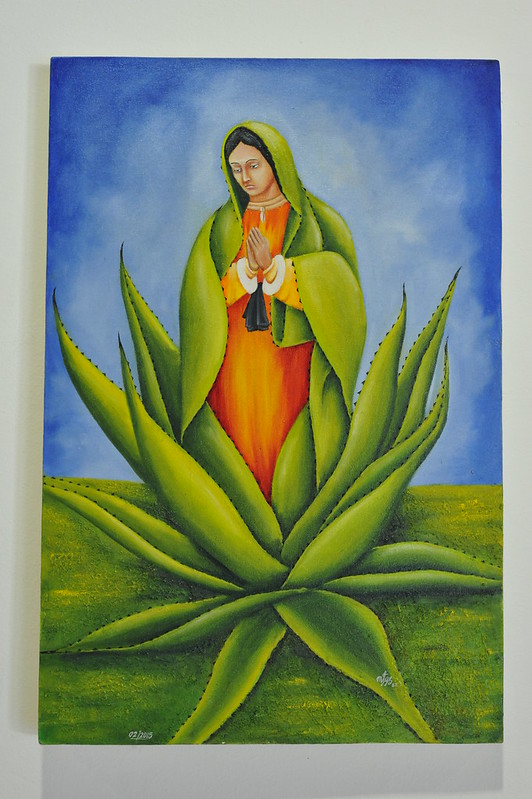
Maguey with Virgen de Guadalupe


Maguey with Virgen de Guadalupe

It's her day. (Read up on Mayahuel here.)

And Chet is eleven! Read Julie's wonderful post here. "Get outside. Smell the air. Look around. Cover ground." Heartfelt amen to that. Happy Birthday, Chet Baker!


December 1, 2015

Cold snap, and two new opuntias

Opuntia sulphurea, on a roll.

With temps below 30F for a few nights, many of the new and/or not-so-hardy plants were crammed under the patio roof...


and covered with frost cloth each evening. Old nursery pots came in handy as covers, too (see far right).


The sun room (odd name, since its windows face north and east) is filled with tender plants, and the garage holds a few more.

Nighttime temperatures for the next ten days or so are expected to be in the 40s F. No rain expected until late next week.

I brought two new opuntia species home from the Mexican Hat nursery. The first is Opuntia sulphurea, shown in the top photo. It's native to Argentina and Bolivia, and has stout pads with long, twisted spines. It's not supposed to be frost hardy, but a Gates C&SS friend who lives a few blocks from me has a big potted O. sulphurea that shrugs at our occasional mid 20F temps and snow. (If it grows in the "high Andes Mountains" one would imagine it to be at least frost tolerant, but several sites rate its hardiness only to zone 9b [25F].) After I bought the plant you see in these photos, the good folks at the nursery tossed in another sulphurea for free — thanks, Mexican Hat! Those twisty spines:

Wiggly: Opuntia sulphurea.

A few links:

Opuntia sulphurea at CactiGuide.
First page of an article from the C&SS Journal on O. sulphurea (October 2013).
Photo of a beautiful plant at the Huntington, via Dave's Garden.

My other new opuntia also has amazing spines, but in this case they are long and straight as knitting needles. The parent plant was growing in the ground at the Mexican Hat nursery, and a kind helper sliced off these paddles for me:

Opuntia quimilo, drying out in the garage with some cholla sections. Weird blue tint on spines produced magically by garage window.

The quimil is another native of South America. Cold hardy to zone 8, maybe. Spines are reported to reach from 8 to 16 inches in length. (Longest spines in the photo above are >4 inches.)

Lots of cool information about the quimil in this post (in Spanish). To wit:

O. quimilo is said to be a favorite hideout of black widow spiders.

The paddles are used as a folk-medicine treatment for venomous snakebites. (Paddles are also used to make a poultice for healing wounds.) It'd be kind of depressing if a black widow bit you while you were trying to break off a paddle to treat your venomous snakebite.

The quimil is a staple of this creature's diet. The pecarí quimilero was apparently known to science only through fossils, and was thought extinct until it was "rediscovered" in the 1970s. From the Wiki link: "It uses its tough snout to roll the cacti on the ground, rubbing the spines off. It may pull off the spines with its teeth and spit them out. The kidneys are specialized to break down acids from the cacti."

Are there any popular North American songs that employ cactus as metaphor? Here's a good one from Argentina. Free translation:

I'd like to be a quimil
rough and stiff-spined
so that no one would shake me
looking for ripe fruit.

It was 38F when I took the dogs out this morning. Spring can come anytime, if you ask me. Thanks to blogger and plantswoman CHACO from Argentina, whose post provided such a wealth of information on the quimil. How intertwined are the lives of plants and people...


November 25, 2015

The good, the bad, and the ugly (Wednesday vignette)

Huey, Louie, and Dewey.

Lock, stock, and three golden barrels: Patty, Maxine, and Laverne? Rock, Paper, Scissors?  Gödel, Escher, Bach? Chico, Harpo, and Groucho? Faith, Hope, and Charity? Tinker, Evers, and Chance? Shake, Rattle and Roll? Wynken, Blynken, and Nod?  Shirley, Goodness, and Mercy? Lies, Damned Lies, and Statistics? 

I'm here all week, folks. Try the turkey! Heartfelt thanks today to the Gates Cactus & Succulent Society. Kind friends, patient mentors, plants for sale each month,  field trips, trades, great guest speakers, and rescue opportunities with nice plants available for a song: all courtesy of Gates. (Need a pickup truck for a rescue? I'm your girl.)

One of the loveliest things about Gates is their willingness — eagerness! — to rehome plants. That's a blessing for a gardener or collector who lives by the adage "Prune with a shovel" (™ Clair Martin, former Huntington rosarian). If a plant isn't working in my 20 x 50 foot space, it's gone. Thanks to Gates, plant and gardener part as friends. Farewells are painless when good homes are waiting in the wings. 

The top photo was taken in July, and now, in late November, only the dudleya at upper left, the tiny trio of barrels barely visible at far right, and the golden barrels — all three of them from a rescue operation — are still here. Negative space? New plants? A nice puzzle for winter.

The Wednesday Vignette meme is hosted by Anna over at Flutter & Hum: follow the link for much vignette goodness. Happy Thanksgiving, all!


November 23, 2015

Thanksgiving Week

Love this parryi. Brought him home from the school garden two years ago, after the district banned spiky plants. Sun, snow... he doesn't care. Errant leaf is from one of the recent Santa Anas. On the right is Salvia mexicana 'Limelight.'

Much for me to be thankful for. Family, friends, beautiful weather, home, health, the whole week off for dogs and gardening and walks and tamales. I'm very fortunate: all loved ones and I live safe and sound here in the most beautiful region on earth.

Over to you, Pope Francis: 

 A prayer for our earth
All-powerful God, you are present in the whole universe
and in the smallest of your creatures.
You embrace with your tenderness all that exists.
Pour out upon us the power of your love,
that we may protect life and beauty.

Fill us with peace, that we may live
as brothers and sisters, harming no one.
O God of the poor,
help us to rescue the abandoned and forgotten of this
earth, so precious in your eyes.
Bring healing to our lives,
that we may protect the world and not prey on it,
that we may sow beauty, not pollution and destruction.
Touch the hearts
of those who look only for gain
at the expense of the poor and the earth.
Teach us to discover the worth of each thing,
to be filled with awe and contemplation,
to recognize that we are profoundly united
with every creature
as we journey towards your infinite light.
We thank you for being with us each day.
Encourage us, we pray, in our struggle
for justice, love and peace.
And a favorite quote from a rabbi: "Our prayers are answered when we are moved to do all that we can."

********

Looking south into the sun this morning. The cholla at upper right, behind the Opuntia basilaris in the old feed trough, looks like an x-ray of itself, spines translucent in the sunlight. That's a little Russelia equisetiformis in the foreground.


Last Sunday, looking north at the same group. That broken pot was one of my favorites :~( I am never throwing it away. To the left of the cholla is a new Opuntia azurea, the second one I've brought home from a UC Riverside Botanic Gardens Plant Sale. Love those spines. 

I stumbled across this Gymnocalycium chiquitanum over at the Mexican Hat Cactus Nursery and couldn't leave without it. It should look more like this. (Scroll down a bit). Beautiful flowers. Needs new soil and a sip of water. Think I'll keep this one inside for the winter.

The closing-shop sale at the Mexican Hat Cactus Nursery was mostly rained out last weekend, and so there are still a few days to visit and grab some very nice plants. There are BIG golden barrels (>2 feet across) for $50 and under, a gorgeous big Aloe marlothii, a huge Agave titanota, and lots of smaller plants. The nice people running the sales will help you dig up plants (if necessary — lots of choice stuff in the ground) and help carry them to your vehicle. No need to bring the wheelbarrow! Cash only. Black Friday freeway traffic will probably be insane, but towards the end of the week I'd like to drive back to the Mexican Hat for one last visit, maybe buy two or three more plants... two big golden barrels to flank the front door...? Hmmm...

Links:


Few things are more beautiful than a Monarch chrysalis, but I'll nominate a Monarch chrysalis hanging on an agave leaf. From a local blog, too: click here, then scroll down and click to embiggen. Also check out this link from the comments: more about the native vs. tropical milkweed debate, by a UC Davis professor. ("Ideologue"? Ouch. Big native plant advocate here, and wouldn't plant tropical milkweed, but look at my patio: I just bought two cactus from Bolivia, for Pete's sake.)

Meanwhile, east of the Mississippi... Julie Zickefoose is an artist and author from Ohio. She has a wonderful blog that I've been following since Chet Baker was a pup. Right now she is getting her garden ready for winter. Japanese maples, sweet potatoes, the story of 'Rio Samba' and the zinnia... and Boston Chet warming himself by the fire. Love that boy.

In the background as I blog, inimitable Chavela Vargas is singing the milonga-candombe 'Negra Maria.' True sad song (and yet so danceable) set during Carnaval in Buenos Aires. Great mix: milonga and candombe from Africa, adopted by descendants of Europeans in Argentina and Uruguay, where these musical influences were crucial to the birth of the tango. And speaking of tango, here's the awesome Gabriel Missé dancing with Analía Centurión at a studio in New York City. Skip ahead to 15:10 and watch them go all Corny Collins Show to Little Richard's Long Tall Sally. (Can't miss Little Richard's all-white 1956 audience.) In my fantasies, warring factions and evil despots hear this song on the radio, and they all put down their weapons and start to dance.

November 18, 2015

It was a dark and stormy night (Wednesday vignette)

 
Overpotted, bare root, waiting for a real pot...

It was cold (mid 30s F), it was blowing a gale (the Lady Banks rose fell over), and there were intermittent downpours, so before it got dark I rounded up the possibly/probably-less-hardy kids and put them under the patio roof. Sharing shelter with the ones above were a tabletop's worth of others, and a box of paddles from the Mexican Hat Cactus Nursery — that's a humongous Opuntia 'Old Mexico' on the left ("previously known as (and may still be listed in various places) Opuntia gomei 'Old Mexico', but recent genetic tests indicate it is a spineless form of Opuntia stricta," says Xenomorf), next to a ginormous Cow's Tongue (Opuntia engelmannii var. linguiformis).

I think I need a bigger pot.

Those two are ready for potting. Next week is Thanksgiving vacation, and the weather should be quite nice for working in the garden. Getting colder, though. I'll have to set up frost cloth central in a week or two.

The Wednesday Vignette is hosted by Anna over at Flutter & Hum — visit the link for much vignette goodness.